UX Research & Strategy
Selected work showing how I use research, systems thinking, and product strategy to solve complex problems across sustainability, edge computing, security, and accessibility. Each case study focuses on translating user evidence into clearer product direction, stronger experiences, and more informed organizational decisions.
AI Strategy · UX Research · Research Operations · Developer Experience · Responsible AI
-
![server lifecycle showing recycling, waste management and responsibility callouts]()
Server Lifecycle Sustainability: Designing for More Responsible Data Center Operations
Sustainability Strategy · Enterprise Research · Systems Thinking
I led global research and strategy to understand how server lifecycle decisions affected sustainability across complex data center environments. By connecting operational realities, stakeholder needs, and environmental goals, the work helped shape clearer decision frameworks and more sustainable approaches to managing infrastructure at scale.
-
![a person's arms and hands at a laptop with AI symbols]()
Shaping Intel Edge AI: Developer Research from Prototype to Platform
OBJECTIVE
As UX Architect, lead research for an emerging Intel edge AI platform. Understand how developers moved from hardware and model selection through inference, deployment, and platform management. Identify barriers across the end-to-end experience and help teams create more usable, self-enabling tools, workflows, and learning paths.
METHODS
Developer Observation and Telemetry: Worked with engineers to instrument complex development workflows, combining behavioral telemetry with direct observation and qualitative findings.
ISV and Ecosystem Research: Led interviews with global independent software vendors building computer vision and edge inference solutions.
Mixed-Methods Research: Reached more than 200 participants through moderated and unmoderated studies, interviews, surveys, prototype evaluations, and longitudinal research.
Technical Workflow Validation: Evaluated hardware and software setup, AI model optimization, video analytics pipelines, developer documentation, deployment, and troubleshooting.
Cross-Functional Strategy: Partnered with engineers, architects, product managers, documentation teams, developer relations, field engineers, vendors, and customers across a global organization.
RESULTS
Identified critical failure points across developer onboarding, configuration, AI model-to-deployment workflows, and platform management. The findings generated a substantial engineering defect backlog and shaped workflow automation, telemetry, documentation, reference solutions, learning paths, use-case priorities, and platform strategy. This research directly influenced Intel’s edge AI portfolio, with especially strong relevance to Intel Tiber Edge Platform, Open Edge Platform, and Intel Smart Edge.
-
![]()
Revolutionizing Password Management: Biometric AI Integration in True Key
OBJECTIVE
Lead the integration of PasswordBox, a cross-platform password manager acquired by McAfee, with McAfee's existing biometric authentication tools. Focus on solving password management issues by incorporating fingerprint and face detection technology. Collaborate with global teams to ensure seamless integration and broad user adoption.
METHODS
Initial Testing and Validation: Conducted rigorous testing and validation of the biometric authentication integration to ensure reliability and security.
Prototyping: Developed and iterated on various login and setup options to enhance user experience.
Browser Integrations: Created seamless browser integrations to extend the functionality and accessibility of the password manager.
Collaboration: Worked closely with engineering and stakeholders across the US, Canada, India, China, and Brazil.
Tools and techniques used included in-depth collaboration with cross-functional teams, participatory design, and iterative testing processes.
RESULTS
Successfully integrated biometric authentication into the True Key product, enhancing its security and user-friendliness. Scaled AI-driven biometric authentication tools from ideation to 2M+ users through iterative improvements using DScout, UserTesting, and UserZoom. Delivered a robust, secure password management solution on time and within budget.
-
![]()
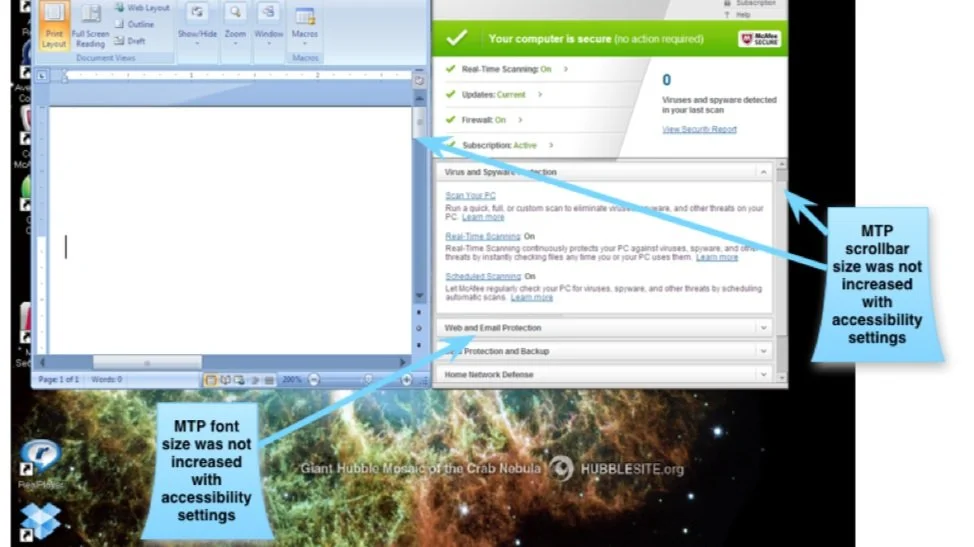
Inclusive Innovation: Redesigning Accessibility for McAfee Total Protection
OBJECTIVE
Enhance the accessibility of McAfee Total Protection desktop software. Address various accessibility issues to ensure the software is usable for individuals with different disabilities. Improve overall user experience and increase adoption among a broader range of users.
METHODS
Keyboard-only navigation
Screen reader compatibility testing (JAWS or Window Eyes)
Screen magnifier testing (Zoom Text)
Voice navigation testing (Dragon Naturally Speaking)
Simulated visual impairments (using or removing glasses)
Simulated motor impairments (using an imprecise substitute for a mouse, such as a trackball or a mouse on a reflecting surface)
Sound adjustments (turning the sound very silent or off)
One-handed usage testing
High contrast mode (setting the screen to black and white to check contrast sufficiency)
RESULTS
Through comprehensive evaluation and targeted recommendations, McAfee Total Protection significantly improved its accessibility features. Key areas such as keyboard access, alternative text, screen reader compatibility, zoom & text control, and high contrast compatibility were addressed. These enhancements led to a more inclusive user experience, ensuring that the software could be effectively used by a wider range of users, including those with disabilities.



Explore more work
-
Featured Work
Selected case studies across AI, UX strategy, research, and product innovation.
-
AI Lab
Personal AI experiments, prototypes, and emerging-product concepts.